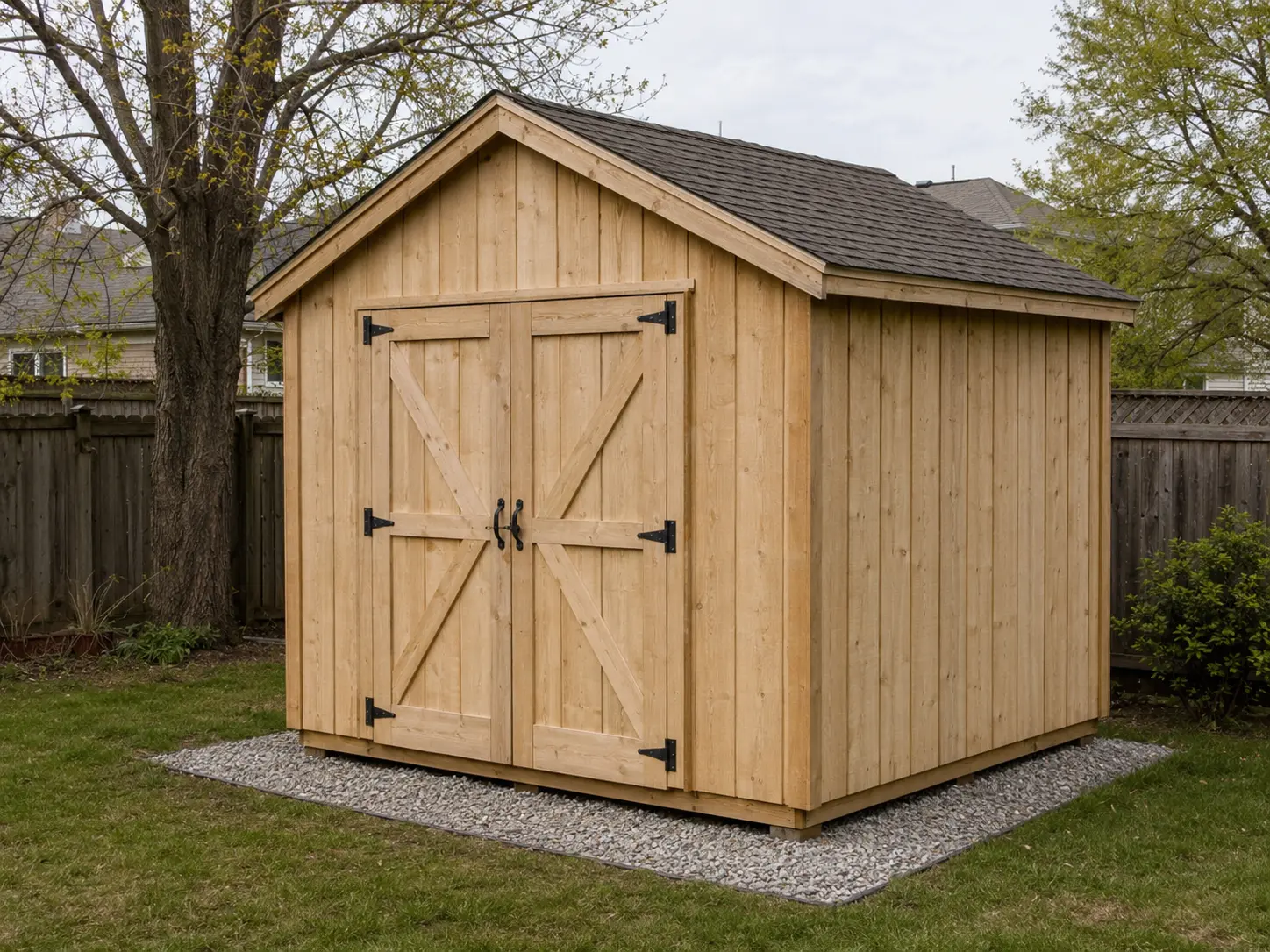
Is It Cheaper to Build or Buy a Shed?
Building a shed from scratch can be cheaper than buying a professionally installed wood shed—especially if you already own the tools and do not assign a dollar value to your labor. But DIY is not automatically the cheapest option. A basic metal or resin kit may cost less upfront, while tools, delivery, permits, foundation work, waste and mistakes can erase the savings of a scratch-built shed. Compare equivalent sheds and calculate the complete installed cost before deciding.
There are really four choices:
- build a wood shed from individual materials;
- assemble a precut wood kit;
- assemble a metal or resin kit;
- buy a delivered or professionally installed shed.
Each option includes a different amount of material, labor and risk. A stack of framing lumber is not comparable to a painted shed installed on your property. The useful question is not “Which price tag is lowest?” It is:
Which option gives me the shed I need at the lowest complete cost—including everything required to make it usable?
Build versus buy at a glance
| Option | Usually strongest on | Usually weakest on | Best fit |
|---|---|---|---|
| Build from scratch | Customization and control | Time, complexity and cost uncertainty | Capable DIYer who already owns tools |
| Precut wood kit | Simpler planning and predictable parts | Limited customization; exclusions vary | DIYer who wants wood without designing every detail |
| Metal or resin kit | Low entry price and reduced maintenance | Customization, repairability and wall-mounting options | Basic outdoor storage |
| Professionally installed wood shed | Speed and predictable assembly | Highest cash price in many comparisons | Buyer who values time and reduced execution risk |
The short decision
- Build from scratch when you already have tools, want a custom result and can manage foundation, framing, roofing and weatherproofing.
- Buy a precut kit when you want to do the labor but reduce measuring, cutting and material planning.
- Buy a metal or resin kit when low-cost storage matters more than traditional wood construction.
- Buy installed when speed, warranty and a more predictable process are worth paying for.
Why most shed cost comparisons are misleading
An incomplete comparison may place $1,800 of lumber beside a $5,000 installed shed and claim that building saves $3,200. But the lumber number may exclude the floor, foundation, roofing, siding, doors, hardware, fasteners, paint, delivery, tools and waste. The installed price may include several of those items.
To compare fairly, use the complete cost:
Complete shed cost = structure + foundation + delivery + tools + consumables + permits + waste + labor + finishing + required site work
The exact categories depend on the shed, but they must be applied consistently.
Compare the same finished result
Before comparing prices, define:
- footprint;
- wall height;
- floor included or excluded;
- foundation type;
- framing material;
- siding and roofing;
- number and size of doors;
- windows and vents;
- paint or finish;
- anchoring;
- delivery and assembly;
- intended use.
A 10 × 12 metal shell with no finished floor is not equivalent to a 10 × 12 wood-framed shed with a treated floor, asphalt shingles, painted siding and double doors.
A current 10 × 12 price snapshot
The examples below are market observations, not universal prices. They were researched on August 22, 2026, and may change by location, availability, promotion and selected options.
| Example | Advertised price observed | Important qualification |
|---|---|---|
| Patiowell 10 × 12 metal shed | About $799 | Product configuration, base, floor, delivery and anchoring must be checked |
| Handy Home Windemere 10 × 12 precut wood kit | About $2,932 | Includes a wood floor; foundation, paint and site preparation still require review |
| Handy Home Kennesaw 10 × 12 assembled wood shed | About $3,503 | Included scope and site requirements must be confirmed |
| Tuff Shed Tahoe Lakeridge 10 × 12 installed wood shed | About $5,509 | Advertised as professionally installed; foundation and local installation conditions still matter |
Sources: Patiowell 10 × 12 metal shed, Home Depot Windemere DIY kit, Home Depot sheds with assembly included, and Home Depot Tuff Shed Tahoe Lakeridge.
These numbers demonstrate why “build or buy” has no single national answer. The cheapest listed product is not the same type of structure as the installed wood shed, and the DIY wood kit is not the same as buying raw lumber.
For a reliable local comparison, price one defined specification using your ZIP code and current delivery terms.
Option 1: Build a shed from scratch
Scratch-building means purchasing individual materials and turning a plan into a finished structure. It offers the most design control and creates the greatest opportunity to choose where to spend or save.
When building from scratch can be cheaper
DIY has the strongest financial case when:
- you already own the necessary tools and accessories;
- you can perform the labor without hiring major portions of the work;
- the design uses locally available standard materials;
- the site requires only straightforward preparation;
- you can transport or receive material efficiently;
- you follow a complete, verified plan;
- customization would be expensive as an upgrade on a purchased shed;
- you do not need the project completed immediately.
The savings come primarily from replacing paid labor with your own time and controlling the specification. You can use simple siding instead of decorative upgrades, place doors where your yard requires them and build shelving into the framing.
When scratch-building may cost more
Building can lose its cost advantage when:
- you need to buy a saw, nailer, ladder, level, clamps or roofing tools;
- material must be delivered in several orders;
- the plan has an incomplete bill of materials;
- mistakes require replacement panels, lumber or roofing;
- the project sits exposed to weather during a slow build;
- you hire out the foundation, framing or roofing;
- custom details increase material and labor;
- your time has a high opportunity cost;
- local requirements demand drawings, engineering or inspections.
First-time builders often estimate only the visible lumber. A complete scratch-built budget must also cover connectors, fasteners, adhesives, underlayment, drip edge, roofing, flashing, vents, trim, door hardware, primer and paint where required.
Scratch-built does not mean “free design”
A buildable shed requires decisions about spans, loads, openings, bracing, water management, anchoring and local conditions. A collection of attractive pictures is not a construction plan.
Before pricing materials, inspect the documentation using our guide to what a good woodworking plan should include. For a shed, that review may need to extend beyond ordinary furniture-plan standards.
Option 2: Buy a precut wood shed kit
A precut kit sits between raw-material construction and a finished shed. The manufacturer chooses the design and supplies a package of parts for assembly.
The potential value is reduced uncertainty:
- the core parts may already be cut;
- material quantities are established;
- doors may be preassembled or pre-hung;
- hardware may be packaged;
- instructions follow a defined system;
- less material-planning time is required.
That convenience has value even when the kit price is similar to the cost of individual materials.
A kit can be cheaper than buying the materials yourself
It is possible. Manufacturers buy in volume, standardize production and may discount a model. A promotional kit can therefore cost less than a one-off retail material list—especially after accounting for delivery and waste.
Do not assume that “doing more work” guarantees a lower price.
What “kit” may not include
The word kit does not establish a standard scope. Depending on the product, the package may exclude:
- foundation or anchoring;
- floor framing or floor panels;
- roof shingles or metal roofing;
- roofing underlayment;
- paint and primer;
- windows or decorative items shown in photos;
- final roofing nails and other consumables;
- unloading or placement;
- assembly labor;
- permits and site preparation.
Read the exact included-components list, installation manual, delivery policy and site requirements before comparing the total with a scratch build.
When a wood kit makes sense
A precut wood kit is attractive when you:
- want to perform the assembly;
- are comfortable with basic tools but not full design and material planning;
- accept the fixed size and construction system;
- value labeled parts and a defined sequence;
- can verify that the kit is complete for your intended result.
It is less attractive when significant modification is required. Moving a door, changing the roof or altering wall height can invalidate pre-cut parts and complicate warranty or code assumptions.
Option 3: Buy a metal or resin shed kit
If the goal is basic storage at the lowest initial price, a metal or resin kit may beat both a custom wood shed and a precut wood kit.
Potential advantages include:
- low advertised entry price;
- components sized for shipment;
- reduced painting and exterior-finish work;
- resistance to rot or insect damage, depending on material;
- lighter components;
- relatively predictable appearance.
But lower price does not make the result equivalent to a wood-framed shed.
Questions to answer before buying
- Is a floor included?
- Is a structural floor frame included, or only a base frame?
- What foundation does the manufacturer require?
- How is the shed anchored for local wind conditions?
- Can the walls support the shelving you intend to install?
- How is condensation managed?
- What do the warranty exclusions say?
- Can damaged panels or hardware be replaced?
- Will packaged components fit through the access route?
- Does the advertised size describe the roof, exterior wall or usable interior?
For bicycles, garden tools and a mower, a low-cost kit may be rational. For a workshop with wall cabinets, heavy equipment, electrical service or insulation, the specification is different and should be evaluated as a different project.
Option 4: Buy a delivered or professionally installed shed
An installed shed typically carries the highest cash price in a wood-to-wood comparison, but the price purchases more than material.
It may include:
- standardized fabrication;
- delivery or on-site assembly;
- an experienced installation crew;
- shorter time from purchase to use;
- reduced demand on your tools and skill;
- a defined product warranty;
- more predictable completion.
Home Depot's current shed installation guide says homeowners spend about $4,500 on average for material, labor and installation, but that figure is broad and should not replace a local quote. See Home Depot's shed installation cost guide.
“Installed” does not always mean all-inclusive
Confirm responsibility for:
- permit applications;
- HOA approval;
- utility location;
- grading and drainage;
- gravel pad or slab;
- access clearance;
- fence removal;
- anchoring;
- paint or touch-up work;
- disposal and yard repair;
- sales tax and surcharges.
Also determine what happens if the crew arrives and the site is not ready. A failed installation visit can create delay or additional charges.
Delivery access can decide the entire purchase
A fully assembled shed needs a route from the street to its final location. Gates, fences, trees, slopes, overhead lines and soft ground may prevent delivery.
Some products are assembled on site instead. That reduces the required object clearance but still requires room for workers, material staging and safe access.
Foundation and site preparation: the shared cost
Every shed needs an appropriate, stable base. Buying a finished structure does not make site conditions disappear.
Possible systems include:
- compacted gravel pad;
- concrete blocks or approved piers;
- ground-contact skids;
- helical or other foundation systems;
- concrete slab.
The correct option depends on the structure, manufacturer instructions, soil, drainage, frost conditions, wind exposure and local rules. This article does not select a foundation for your property.
Why foundation cost changes the answer
A level, accessible site with suitable drainage may require modest preparation. A sloped or wet site can require excavation, retaining work, additional base material or professional help.
Angi reported a 2026 range of roughly $1,100 to $1,700 for professional gravel-pad installation, depending on pad size and site complexity. Treat that as a contextual estimate—not a quote. The same foundation cost may apply whether you build the shed or buy it. See Angi's gravel pad cost guide.
When comparing options, either include the same foundation in every column or separate it as a shared site cost.
Tool costs can erase DIY savings
A scratch-built wood shed may require access to:
- circular saw or miter saw;
- drill and impact driver;
- appropriate blades and bits;
- framing square and reliable level;
- ladders or work platforms;
- clamps and temporary bracing;
- roofing tools;
- safety equipment;
- material-handling equipment.
The list varies with the plan and construction method. A kit may reduce cutting but still require drilling, fastening, leveling and roof work.
Count only the appropriate portion of reusable tools
There are two reasonable accounting methods:
- Cash-flow method: count the full purchase price because that is what leaves your account now.
- Project-cost method: assign only part of a reusable tool's cost when you expect to use it regularly after the shed.
Show both if the decision is close. Do not pretend that a $300 tool was free, but do not charge its full cost to every future project either.
Renting or borrowing may improve the DIY case. It can also add scheduling pressure and repeated rental charges if the build runs late.
What is your time worth?
DIY comparisons often set labor to zero. That is acceptable only if the question is strictly, “How much cash will I spend?” It is not a complete economic comparison.
Use two totals:
Cash cost = every dollar paid to complete the shed
Economic cost = cash cost + value assigned to your labor
For example, if DIY saves $1,500 in cash but requires 75 hours, the apparent saving equals $20 per hour before accounting for delays or corrections. That does not mean you should charge yourself exactly $20 per hour. It shows what you are exchanging.
Your labor may still be worthwhile when:
- building is recreation or education;
- you want the skills for future projects;
- customization has personal value;
- the project can proceed without a costly deadline.
Buying may be economically stronger when the same hours would displace paid work, family commitments or another project with higher value.
Waste, mistakes and contingency
Real projects do not use every board and panel perfectly. A budget should allow for:
- saw kerf and trim loss;
- defects and unusable sections;
- grain or appearance selection;
- damaged material;
- measurement and cutting errors;
- design corrections;
- price changes or additional delivery.
Do not hide contingency to make DIY look better. At the same time, do not assume every beginner will waste an arbitrary percentage. Build the material list first, identify risk-heavy operations and add a documented allowance appropriate to the plan.
A kit shifts some cutting risk to the manufacturer but introduces other risks, such as missing or damaged components. Review the claims process before assembly begins.
Permits, zoning and HOA rules
The model 2024 International Residential Code lists an exemption from a building permit for certain detached, one-story accessory structures not exceeding 200 square feet. However, local jurisdictions decide which code and amendments apply, and other approvals may still be required. See 2024 IRC Section R105.2.
A shed under 200 square feet is not automatically permit-free where you live.
Check locally for:
- permit threshold;
- zoning and setbacks;
- maximum height;
- lot coverage;
- foundation or anchoring requirements;
- wind, snow or wildfire provisions;
- easements;
- HOA design approval;
- restrictions on electrical or plumbing work;
- rules that change when storage becomes a workshop or occupied space.
An online plan, retail listing or salesperson cannot approve your property. Verify the address-specific requirements before ordering material or a nonreturnable shed.
A fair 10 × 12 comparison worksheet
To compare a scratch-built shed, a wood kit and an installed shed, start with one shared specification:
- 10 × 12-foot footprint;
- wood-framed storage use;
- treated wood floor system;
- double door;
- basic asphalt-shingle roof;
- exterior siding and trim;
- no electrical service;
- no insulation or interior wall finish;
- comparable foundation;
- delivery to the same ZIP code.
Then complete this table with actual quotes:
| Cost category | Scratch build | Precut wood kit | Installed wood shed |
|---|---|---|---|
| Structure or core material package | $ | $ | $ |
| Floor included? Add if excluded | $ | $ | $ |
| Roof materials included? Add if excluded | $ | $ | $ |
| Doors, windows and hardware | $ | $ | $ |
| Foundation and site preparation | $ | $ | $ |
| Delivery and unloading | $ | $ | $ |
| Required tools or rental | $ | $ | $ |
| Fasteners and consumables | $ | $ | $ |
| Primer, paint and finishing | $ | $ | $ |
| Permit, plans and local fees | $ | $ | $ |
| Waste and correction allowance | $ | $ | $ |
| Paid labor | $ | $ | $ |
| Sales tax and known surcharges | $ | $ | $ |
| Complete cash cost | $ | $ | $ |
| Estimated personal labor hours | h | h | h |
| Optional value of personal labor | $ | $ | $ |
| Economic cost | $ | $ | $ |
Do not fill missing inclusions with zero. Mark them “unknown” until verified. An unknown foundation or delivery charge can be larger than the visible difference between two options.
When is it cheaper to build a shed?
Building from scratch is most likely cheaper when all or most of these are true:
- you already own the tools;
- the design is simple and well documented;
- you can do nearly all the labor;
- standard local materials match the plan;
- the site is straightforward;
- delivery costs are controlled;
- you need customization that would be a paid upgrade;
- your schedule allows for delays;
- you value the building experience;
- the cash comparison includes every finishing item.
Even then, obtain at least one comparable kit and installed price. A sale or local supplier may change the result.
When is it cheaper to buy a shed?
Buying can be cheaper—or provide better value—when:
- a metal or resin kit meets the actual storage need;
- a discounted wood kit costs less than the retail material package;
- you would need to buy many tools;
- you would hire significant portions of the DIY build;
- mistakes would be expensive;
- completion speed matters;
- weather exposure during construction creates risk;
- a standardized model includes useful doors, floor and roofing;
- delivery and installation are available on a prepared site;
- your time has meaningful opportunity cost.
The winning option may be a kit rather than either extreme. That is why a three-column comparison is more useful than a simple build-versus-buy argument.
Choose based on the real job
| Your situation | Start by pricing |
|---|---|
| Cheapest basic garden storage | Metal or resin kit |
| Wood shed with DIY labor but less cutting | Precut wood kit |
| Custom door placement, roof or dimensions | Scratch-built shed |
| Fast completion with minimal owner labor | Professionally installed shed |
| Existing tools and construction experience | Scratch build and kit side by side |
| No tools and limited free time | Kit with assembly or installed shed |
| Sloped, wet or difficult site | Site contractor before choosing the structure |
| Future workshop, electrical or conditioned use | Purpose-specific design and local review |
Do not buy a workshop based on a storage-shed price. Once you add electrical service, insulation, interior finish, substantial equipment or occupancy, the project scope and local requirements can change materially.
Frequently asked questions
Is it cheaper to build a shed from scratch or buy a kit?
It depends on the kit price, what it includes and what tools you already own. Scratch-building can save money through unpaid labor and material control, but a discounted kit may cost less than an equivalent retail material package and reduce waste or errors.
How much can you save by building your own shed?
There is no dependable national savings amount. Compare equivalent size, floor, foundation, roofing, siding, doors, finish, delivery and permits. The cash difference is your potential saving before assigning value to your time.
What is the cheapest type of shed?
For basic storage, small metal or resin kits often have lower advertised prices than wood sheds. Confirm whether the base, floor, anchoring and delivery are included and whether the shed meets your climate and storage requirements.
Is a wood shed kit cheaper than buying lumber?
It can be. Standardized production, bulk purchasing and promotional pricing may allow a kit to compete with or beat a one-off retail material list. Compare the exact included components rather than assuming raw material is cheaper.
Does a shed kit include the foundation?
Not necessarily. Some include a floor frame or floor panels, which are not the same as a prepared foundation. Read the product requirements and price the site work separately.
Do you need a permit for a 10 × 12 shed?
Possibly. A 10 × 12 shed is 120 square feet, but permit, zoning, setback, anchoring and HOA rules vary locally. Do not assume that being below the 200-square-foot threshold in a model code exempts the project at your address.
How long does it take to build a shed?
The time depends on site preparation, design, builder experience, help, weather and finish. Manufacturer assembly estimates apply only under their stated conditions and may exclude foundation, painting or permit delays.
Is building a shed difficult for a beginner?
It can be a substantial first construction project. It combines layout, framing, sheet handling, roofing, doors, weather management and work at height. A beginner should use complete plans, verify local requirements and obtain help for operations beyond their ability.
Should tools count toward the cost of a DIY shed?
Yes. For cash-flow planning, count the full amount you must spend now. For a long-term project-cost comparison, you may also show a second calculation that allocates part of a reusable tool's cost to the shed.
Does a DIY shed add property value?
Do not assume it will return its cost. Value depends on quality, legality, condition, location and buyer preference. A poorly placed or unpermitted shed may be a liability rather than an improvement.
Bottom line
Building a shed from scratch often beats a professionally installed wood shed on cash cost when you already have tools, perform the labor and control the design. But it does not automatically beat a precut kit, and it may never beat a basic metal or resin shed when simple storage is the only goal.
Buying usually wins on speed and predictability. Building wins on customization and may save cash. A kit can occupy the practical middle.
The honest answer comes from three steps:
- define one equivalent finished shed;
- calculate the complete installed cost of every option;
- decide whether your time, learning and execution risk belong in the comparison.
If a price excludes the foundation, delivery, tools or finish, it is not yet the price of a usable shed.
Related guides
- How Much Does It Cost to Build a Shed Yourself?
- What Should a Good Woodworking Plan Include?
- Free vs. Paid Woodworking Plans: Are Paid Plans Worth It?
- How to Start Woodworking on a Budget
- How Much Does It Cost to Start Woodworking?
Research and price methodology
Product examples were captured from publicly available U.S. retail pages on August 22, 2026. They illustrate the range of purchasing models; they are not endorsements, quotes or claims that the products are equivalent. Prices, availability, included components, delivery and installation terms can change by location and date.
The Practical Woodshop did not purchase, assemble or independently test the products cited in this comparison. Product features are identified from retailer or manufacturer listings and should be confirmed on the current product page before purchase.
Code context comes from the 2024 International Residential Code. Local adoption, amendments, zoning and property-specific requirements control the real project.
This article provides a decision framework, not structural, engineering, permitting or installation approval.